
Home > Restore and Recover Your Data > AvePoint Cloud Backup > Restore Teams Data
Download this articleRestore Teams Data
If a team has been deleted from the original location, the restore job can recover that team and the permissions of the owner and members to its original location. To view the supported and unsupported data types of Teams, refer to Teams Data Types.
You can also choose to restore partial Teams data to another location. Cloud Backup for Microsoft 365 now supports restoring the files in a standard channel or a Team site to another channel site or Team site. Additionally, AvePoint Cloud Backup now supports out-of-place restore operations between SharePoint Online sites, OneDrive, Teams sites, and Group sites. For details on which data types are supported for being restored to another location, refer to Teams Restore Options.
AvePoint Cloud Backup service for Teams also provides the option allowing you to restore a soft-deleted team from the Microsoft 365 recycle bin to its last known good state. AvePoint will perform a check for the team status in Microsoft 365 to ensure Microsoft has this data and present the options for you to decide the best way to recover data: using Microsoft native restore function within that 30-day retention period or using AvePoint backup data to roll back the entire team or granular contents.
The check will only happen when you select the team as both the restore scope and the search level.
Before you restore Teams data, note the following:
-
To restore the Private/Shared Channel data, you can only use the Calendar mode restore wizard to restore the data to its original location. Private Channels have a lock icon displayed next to their name.
-
To restore settings in Teams, the Microsoft 365 service account used to perform the restore must be the owner of the team that you want to restore.
-
If you want to restore documents or security to another Team and the related users in the backup do not exist in the destination team, the permission of these users will not be kept. They will not have access to the restored documents in the destination Team.
-
The accounts’ profile photos in Teams cannot be restored.
-
For Channel restoration, only the existing channels can be restored since users cannot recreate a pre-existing channel name. For the soft-deleted channels that are stored in the Recycle bin of the team site, you can manually restore them from your Microsoft 365 tenant. Once a channel name has been created, even if it is deleted, it cannot be recreated either through the API or Teams interface. The system maintains this data for information protection scenarios.
-
When restoring Standard Channels without an existing team to their original location, the Microsoft Import API is used by default to preserve high fidelity. To use the Graph API, contact AvePoint Support.
Note the following for the Microsoft Import API:
-
The team creation time cannot be kept.
-
If a team with the same email address already exists in the destination, the random digits will be appended to the address to prevent duplication.
-
Reactions to messages cannot be restored.
-
Messages including file links cannot be restored.
-
Messages containing hosted content, such as screenshots or codes pasted directly to the chat, cannot be restored.
-
-
To restore comments added to Planner tasks, you must configure an app profile for the Microsoft Delegated app in AvePoint Online Services and select the Restore Planner task comments function when consenting to the app profile.
-
The past conversations can be recovered as read-only HTML files or as new posts to the channel.
-
If you restore the conversations to HTML files, the conversations that are created within the same month will be restored to the same HTML file named in the following format: ChannelName_January 2018. Each HTML file will store up to 10,000 records. If the number of records exceeds 10,000, the HTML files will be created with a postfix attached to the file name, for example, ChannelName_January 2018_1.
-
If you restore the conversations as new posts, the product will post a new message to the channel's Posts with the original message's sender information and sent date in the message body. The new message is posted in the name of the service account or the Delegated app authentication user, depending on the authentication method you choose to scan Teams. To use this feature, you can either use service account authentication or app profile authentication to scan Teams, but you must have a Microsoft Delegated app connected to your tenant. For details on creating an app profile for Microsoft Delegated, refer to Create an App Profile. Note that the authentication user of the delegated app must have a Teams license and an Exchange Online license.
NOTE-
Only the backup data generated in a new backup cycle after June 1, 2021, can be used to restore the conversations as posts.
-
A restore job to restore conversations as posts via the delegated app will add the authentication user to Teams members or private channel members and then automatically remove them after the restore job completes.
-
-
-
If there are conversations that have not been backed up before the channel was renamed, these conversations posted before the renaming will be restored to a new folder named by the previous channel name under the General channel.
-
Does not support backing up and restoring folders added through the Add cloud storage method under the Files tab in channels.
Complete the steps below to restore Teams data:
-
Navigate to the Restore > AvePoint Cloud Backup page, and then click the Teams tile.
-
Select the data that you want to restore. You can choose one of the following methods to find the data to restore.
-
Search mode – Select a restore object scope and search for the data to restore. Follow steps 3 to 4.
-
Calendar mode – Select a recovery point (backup job) and select data from that backup to restore. Proceed to step 5.
-
-
Define a Team as the search scope. You can enter the Team’s name or email address to search, and then select the Team from the Name list. The default search condition is to search the backup data for the Team within the last backup cycle. The drop-down list will remind you of teams with unusual activities or under potential ransomware attacks.
-
You can choose to use the properties on the same page to search for the contents within this team for granular data roll-back, or you can directly proceed to the next step to search and select the data to restore.
NOTEIf the team you want to restore has been deleted from Microsoft 365, you can let AvePoint Cloud Backup check if the team is still in soft-deleted status and exists in the Microsoft 365 recycle bin to help you decide the best way to restore. In this case, select that team and directly click Search.
If the team is still in soft-deleted status in Microsoft 365, you can choose the following methods:
-
If you choose to restore the entire scope from Microsoft 365, click Next and then select a recovery point. Click OK to start the restore job. You can navigate to the Microsoft 365 environment to monitor and verify the progress.
NOTEIf you only want to restore the scope from the recycle bin for its last known status, we strongly recommend selecting this option for faster job performance and better data integrity.
-
If you choose to restore the selected scope or just content within this scope from backup data, click Next, and you can configure search settings to search for the granular contents.
For the details of using the properties on the first page or the Search feature on the Select and restore the data step, refer to the steps below:
-
In the Name field, you can enter or select another team to change the search scope.
-
In the Backup Time Range field, the time range of the last backup cycle is displayed by default. Click the Calendar button to customize the backup time range. The start date must be earlier than the end date. You can click Reset if you want to reset the settings. Click OK to save your customization.
-
Select Teams, Folder in mailbox, Mailbox item, Group team site, Site, List/Library, App, Folder in SharePoint, Document, Plan, or Task from the Level list for the items you want to search. If you want to search for all objects at the level, you select from the selected Team. You can leave the search conditions empty.
-
Click Search to search the items according to the conditions you configured. The search conditions and the search results are displayed. The search results table will display a maximum of 2000 items. You can edit the search conditions and click Search to adjust the search results.
-
Find and select the item you want to restore from the search results. In the Recovery point column, click the Calendar button to select a backup job that backed up this item at the status that you want to restore, and click Apply. Recovery points with objects with unusual activities detected or potential ransomware attack detected will be displayed with
 (Unusual activities detected) or
  (Potential ransomware attack detected).
 -
You can preview a file’s content by clicking its document name. In the preview window, use the buttons located in the upper-right corner to download, print, or generate a public link for the file. When downloading the file, set a password. This password will be required to open the downloaded file. When generating a public link, set both an expiration date and a password to ensure security.
The preview function supports the following file types: Word (DOC, DOCX, RTF, DOT, DOTX, and DOTM), Excel (XLS, XLSX, XLSB, XLT, XLTX, CSV, and TSV), PowerPoint (PPT, PPTX, PPS, POT, PPSX, PPTM, PPSM, POTX, and POTM), and PDF.
NOTEFiles that have sensitivity labels with encrypted data, contain archived data, or exceed 10 MB in size cannot be previewed.
-
Click the Restore button above the search result table to restore all selected items.
-
Proceed to step 6 to continue with the Restore settings.
-
-
Find a backup job that backed up the items at the time of the status you want to recover, and then search and select the items from the backup data of that backup job.
-
In the calendar, all backup jobs of Teams are displayed. You can select whether to display the finished with an exception or failed jobs in the calendar by selecting the Include jobs with only partial backup data option. Note that the data of these jobs may be incomplete. Hover over a backup job to show the backup job details.
-
Select a backup job. By default, all backup data of Teams, up to a maximum of 2000 items, are displayed in the table, including historical data from previous backups that contribute to the snapshot at that moment. You can select the Show data from this backup only to only show the data backed up in the selected backup job. Recovery points with objects with unusual activities detected or potential ransomware attack detected will be displayed with
(Unusual activities detected) or (Potential ransomware attack detected). -
You can enter keywords to search the items, or you can click the backup data to browse the items you want to restore. After expanding a Team node, you can select the Show Team site and Channel sites checkbox under the table to show the Team site and Channel sites node. You can select the site to restore or browse down to find the content that you want to restore.
-
You can preview a file’s content by clicking its document name. In the preview window, use the buttons located in the upper-right corner to download, print, or generate a public link for the file. When downloading the file, set a password. This password will be required to open the downloaded file. When generating a public link, set both an expiration date and a password to ensure security.
The preview function supports the following file types: Word (DOC, DOCX, RTF, DOT, DOTX, and DOTM), Excel (XLS, XLSX, XLSB, XLT, XLTX, CSV, and TSV), PowerPoint (PPT, PPTX, PPS, POT, PPSX, PPTM, PPSM, POTX, and POTM), and PDF.
NOTEFiles that have sensitivity labels with encrypted data, contain archived data, or exceed 10 MB in size cannot be previewed.
-
The following actions are provided for the restore:
-
You can select the items you want to restore and then click the Restore button above the table to restore selected items.
Note that the restore settings will only show the options that support all the selected objects. For example, if you select Team site, Meetings, and Group Conversations at the same time, the restore settings will not display the Restore security only option, and the Would you like to restore the permissions of external users settings.
-
To restore teams, you can select the teams you want to restore, and then click the Queue for restore button above the table to add them for batch restore. To import multiple teams from a CSV file, click the Bulk import to queue button.
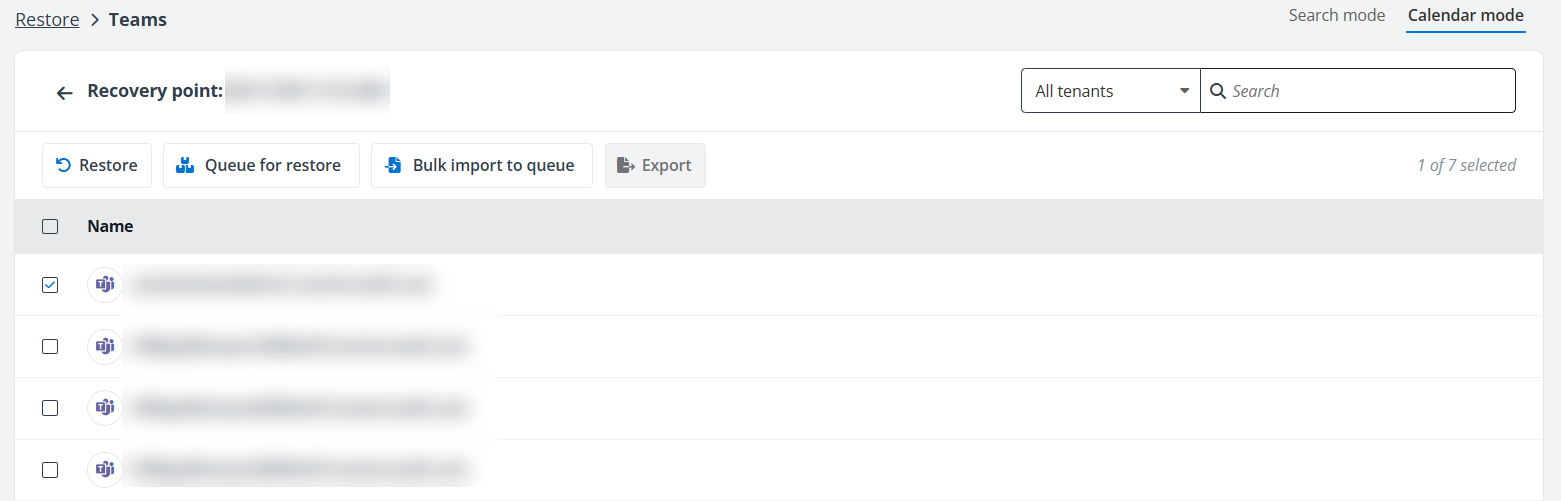
After adding all desired teams to the queue, click the Restore queue (
 ) icon at the top of the page, and then click the Restore button to restore the teams in one restore job. In the Queue for restore panel, you can also click the Want to bulk import objects to the queue? link to import multiple teams from a CSV file.NOTE
In the restore process, the teams in the Restore queue will be restored sequentially from first to last as listed. The objects in the Restore queue are ordered by their addition time, from oldest to newest. The batch import maintains the order of objects as specified in the uploaded template.
If you leave the recovery point, the restore queue will be cleared.
-
-
Continue to step 6 to configure the Restore settings.
-
-
If necessary, you can enter a description for this restore job in the Description text box. For objects with unusual activities or under ransomware attacks, you can click the Potential ransomware attack detected or Unusual activities detected in the Suggested field below to enter it in the Description text box directly.
-
Choose where to restore the backup data.
-
Restore the data to its original location – Restore the backup data to where the data is backed up.
-
Restore the data to another location – Restore the backup data to another destination. Configure the following settings:
-
Select a restore destination – If you select a Teams site or site item, you can select to restore the backup data to SharePoint Online, OneDrive, Microsoft 365 Groups, or Teams. For others, select a container as the restore destination. You can enter keywords to search for the restore destination. The items that can be selected as the restore destination are listed under the Search box.
-
Action – Select how the backup data will be restored to the destination. Select Attach to restore the contents as children beneath the selected node, or select Merge to add the contents to the destination node. For example, you want to restore a folder to another folder. If you select Attach, the restored folder will become the subfolder of the destination folder; if you select Merge, the subfolders and contents of the restored folder rather than itself will directly become the subfolders and contents of the destination folder.
-
-
Restore the data to your storage – If you have selected the Channels, Conversations, or Files, and you have the BYOS subscription, this option is available. You can restore the Channel’s conversations and files to your storage.
-
-
Select how to handle conflicts in the restore job. The available conflict resolution options will vary for the items you select to restore.
-
Container level conflict resolution – Select how to handle conflicts at the container level.
-
Skip – The settings of the conflicting destination container will be retained in the destination.
-
Merge – The source container settings and the content will be merged to the conflicting destination container. With Merge as the container level conflict resolution, the Privacy, Name, and Description will be updated to the destination team, and the team owner and members of the source team will be added to the destination.
-
Replace – The settings of the conflicting destination container will be deleted and replaced by the source container settings, as well as the content within the container.
NOTEThe Replace option is unavailable when you select the whole Team to restore.
-
-
Content level conflict resolution – Select how to handle conflicts at the content level.
-
Skip – The conflicting destination content will be retained in the destination, and the backup data of the conflicting content will not be restored.
-
Overwrite – The conflicting destination content will be removed from the destination, and the backup data of the conflicting content will be restored.
-
Overwrite by Last Modified Time – If the last modified time of the conflicting destination content is earlier than that of the source content, the conflicting destination content will be removed from the destination, and the backup data of the conflicting content will be restored.
-
Append an “_1” to the Item/Document – If the last modified time of the conflicting destination content is the same, the restore will be skipped; if the last modified time is different, the conflicting destination content will be kept, and the backup data of the conflicting content will be added to the destination with a sequential number suffix added to the filename.
NOTEIf you want to restore a single file version without affecting other versions, set the content level conflict resolution to Append an “_1” to the Item/Document. If the content level conflict resolution is set to Overwrite, the restore job will remove all the versions of this file from the destination and keep this file version as the latest and only version of the file.
-
-
Apps conflict resolution – Select how to handle the apps conflict.
-
Skip – The conflicting destination app and AppData will be retained in the destination, and the backup data of the conflicting content will not be restored.
-
Overwrite – The conflicting destination app and AppData will be removed from the destination, and the backup data of the conflicting content will be restored.
-
-
-
Expand the Advanced settings area to configure more restore settings. If you choose to restore to another location, the mapping settings will be available.
-
User mapping – Select a user mapping profile from the drop-down list. For more instructions on creating a new user mapping profile, refer to Configure Mapping Settings.
-
Language mapping – Select a language mapping profile from the drop-down list. For more instructions on creating a new language mapping profile, refer to Configure Mapping Settings.
-
Select how you would like to restore the channel conversations. You can choose to restore the channel conversations to the read-only HTML files (stored in Files) or restore them as the new posts in the channel. If you want to restore the channel conversations as posts, you must have a Microsoft Delegated app registered in your tenant. For details on configuring the app, refer to Create an App Profile.
NOTE-
Only the backup data generated in a new backup cycle after June 1, 2021, can be used to restore the conversations as posts.
-
If your Teams are scanned using app profile authentication, a restore job to restore conversations as posts will add the authentication user to Teams members or private channel members and then automatically remove them after the restore job completes.
-
-
Choose how you would like to restore the version history if file versions are backed up by AvePoint Cloud Backup. You can select to Restore the latest version only, or you can select the Restore the current and previous versions option and enter the maximum number of versions you want to restore in the box. AvePoint Cloud Backup service can restore up to 20 versions of one document. For the best performance and simplest experience, AvePoint recommends restoring only the latest version.
Note the following:
-
By default, history versions of items and files are not backed up due to the regular recovery points created by backup jobs, as well as Microsoft 365 API overhead and limitations related to versions. In our experience, most user and legal requests are only for the most recent active version. In addition, we will capture multiple roll-back points during our daily backups to ensure you have a change history for this document outside native versioning. If you need to back up the versions for some reason and are willing to accept the performance impact, please contact AvePoint support to have it enabled. The backup job will include the most recent 10 versions by default.
-
If you want to restore earlier versions of a document, you can run an export job to export all versions of that document from the backup data.
-
This restore setting is not available when selecting documents.
-
-
Select how you would like to restore the Managed Metadata Service.
-
If the containers or content you select to restore is under the site collection level, the Restore terms in site store only option and the Restore terms in both global term store and site term store option will only restore the terms and their parent terms associated directly with the data from the site store or both. Note that if the data is not restored due to the conflict resolutions you choose, the restored terms cannot be connected to the data either.
-
If you select at least the site collection level object to perform the restore, the Restore terms in site store only option will restore all the deleted terms in the site store and the Restore terms in both global term store and site term store option will restore all the deleted terms in both the global term store and site term store.
-
If you select to Use existing terms only, no terms will be restored.
-
If you want to perform a term store-only restore, refer to the FAQ How do I perform term store-only restore? in Backup and Restore.
-
-
Turn on/off the switch to define whether to restore the sharing permissions. This feature only works for the sharing of items with specific people inside or outside your organization. For external users, the restore job can only restore the permissions for the users who have accessed the sharing link. After the restore, the sharing links will be changed, and OneDrive users can navigate to OneDrive > Shared library to view the content shared with you and shared by you. The links generated by the Copy link function in Microsoft 365 are also regarded as sharing links.
NOTEThe Sharing setting is a tenant-level setting, and the AvePoint Cloud Backup service does not protect tenant settings. The restore job to restore a deleted site cannot restore the Sharing settings, including the external users and their permissions.
-
Turn on/off the switch to define whether to restore the hub site connection. This option is only available when you select a Team or a Team site to restore.
NOTECloud Backup cannot restore the hub site connection for the selected site, if it is a cross-tenant restore or the destination hub site requires approval for the associated sites to join.
-
Turn on/off the switch to define whether to allow restore jobs to rehydrate the data sets automatically when the backup data is stored in the Azure archive storage tier. This field is only functional for the BYOS subscription type. For AvePoint default storage, the restore job will automatically rehydrate data.
-
Turn on/off the switch to define whether to restore guest user memberships. Note that this applies to standard and private channels only, as shared channels do not support guest users.
-
Turn on/off the switch to define whether to enable the Custom Scripts setting during the restore. This feature allows you to restore data related to scripts to the destination Microsoft environment.
-
Click Next to view the restore summary.
-
Click Restore to restore the selected items. After the job has started, you can navigate to the Job monitor to view more job details. For details, refer to Job Monitor.